
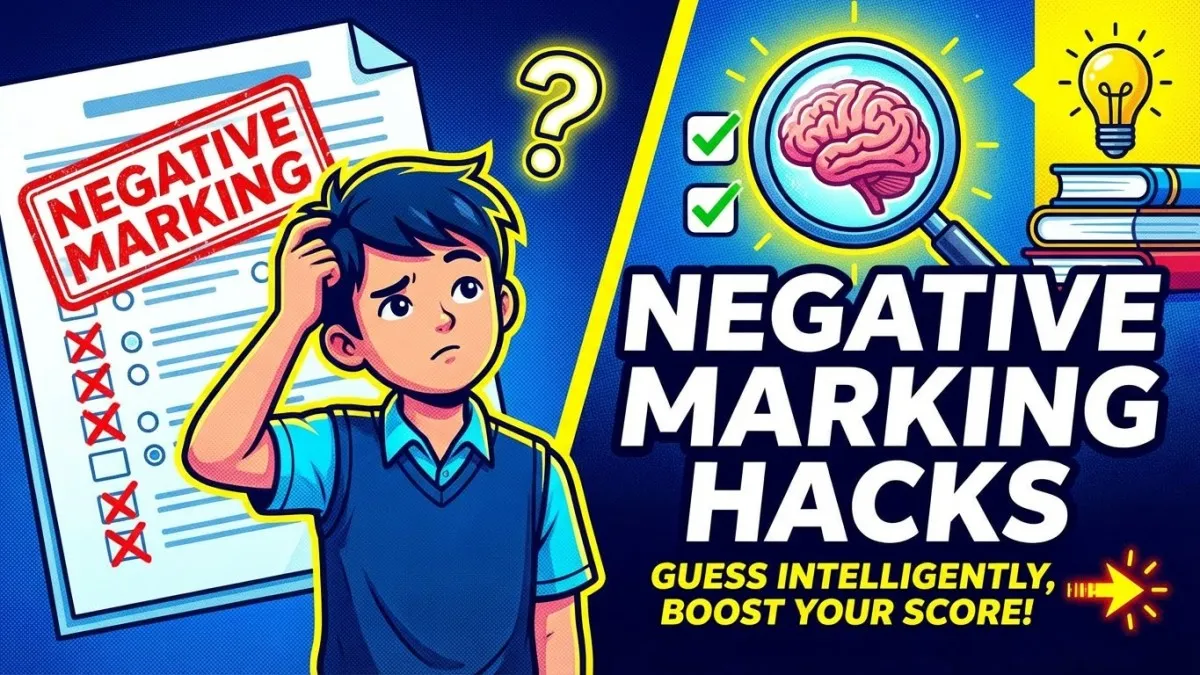
This ONE Mistake Cost Me 12 Marks (Don’t Repeat It)
How to Guess Intelligently When You Are Confused
Picture this:
You’re sitting in the SSC CGL exam hall.
Question number 47. You’re confused between options B and C.
Your heart is racing. Clock is ticking.
You randomly mark option C.
Wrong answer. -0.50 marks gone.
Next question. Same confusion. You guess again. Wrong. Another -0.50 gone.
By the end of the exam, you’ve lost 12 marks just because of random guessing.
That’s the difference between selection and rejection.
I know this pain because I’ve been there.
And I’ve also mentored 5,000+ students who make this SAME costly mistake every single day.
Today, I’m going to teach you something NOBODY talks about:
How to guess INTELLIGENTLY when you don’t know the answer.
Yes, you read that right.
There’s a science to guessing in government exams.
And once you learn it, negative marking won’t scare you anymore.
Let’s start.
The Reality Check: Why Random Guessing Is Killing Your Score
Let me tell you a harsh truth.
In SSC, Railways, and other Govt Exam Preparation 2025 exams, negative marking is NOT your enemy.
Random guessing is.
Here’s what most students do wrong:
❌ Mistake #1: They Guess on EVERY Confused Question
You don’t know the answer? You still mark something.
“Chalo, kuch toh try kar lete hain.”
Result: You lose more marks than you gain.
Reality: If you’re 100% clueless (can’t eliminate even 1 option), you should SKIP the question.
The math is simple:
- If you guess randomly among 4 options = 25% chance of being right
- But negative marking = -0.50 for wrong answer
- Expected value = (0.25 × 1) – (0.75 × 0.50) = +0.25 – 0.375 = -0.125 (NET LOSS)
Translation: Random guessing makes you LOSE marks in the long run.
❌ Mistake #2: They Don’t Use the Elimination Technique
Most students look at a question and think:
“I don’t know this. Let me guess.”
Wrong approach.
Smart students think:
“I don’t know the right answer. But can I eliminate 1-2 WRONG options?”
That changes everything.
❌ Mistake #3: They Panic and Waste Time
Confused question → Panic → Waste 2 minutes thinking → Still guess randomly → Wrong answer.
Double loss: Time wasted + Marks lost.
Better strategy: Use elimination → Make educated guess in 30 seconds → Move on.
❌ Mistake #4: They Don’t Track Their Guessing Accuracy
You guess 20 questions in a mock test.
You don’t check: “How many guesses were right?”
So you never improve your guessing skills.
Top students track this. They know their guessing accuracy rate. They improve it with practice.
The Solution: 4-Step Intelligent Guessing System
Now let me teach you the RIGHT way to handle confusion in exams.
This is the same system toppers use. This is part of smart Exam Strategy.
Step 1: Use the “Elimination Rule of 2”
The Golden Rule:
Never guess unless you can eliminate at least 2 options.
Here’s why:
If you can eliminate 2 options, you’re choosing between 2 options (50% chance).
New math:
- Probability of right answer = 50%
- Expected value = (0.50 × 1) – (0.50 × 0.50) = +0.50 – 0.25 = +0.25 (NET GAIN)
You’re now GAINING marks through intelligent guessing.
How to eliminate options:
In Reasoning:
- Check for patterns that don’t match
- Eliminate options that violate basic logic rules
- Look for odd-one-out in answer choices
In Quantitative Aptitude:
- Eliminate options that are too large or too small
- Check if option matches the unit (if answer should be in %, eliminate whole numbers)
- Use approximation to rule out impossible values
In English:
- Eliminate grammatically incorrect options first
- Remove options with spelling mistakes (yes, SSC sometimes has them)
- Trust your “ear” – read the sentence aloud mentally
In General Awareness:
- Eliminate options that are factually impossible
- Remove options with wrong date ranges (e.g., if question is about 2020, eliminate options mentioning 2018 events)
- Use common sense to remove absurd options
Step 2: Apply the “Commonality Principle”
This is a SECRET trick most students don’t know.
When you’re confused, look for patterns in the options.
Example:
Question: What is the capital of Arunachal Pradesh?
A) Itanagar
B) Imphal
C) Dispur
D) Shillong
You’re confused. You don’t know.
But wait. Look at the pattern:
- Options B, C, D are capitals of Manipur, Assam, and Meghalaya (all Northeast states)
- Option A also “sounds” like a Northeast name
- But B, C, D are CONFIRMED capitals of other states
- So the question must be about a DIFFERENT state
Eliminate B, C, D. Choose A.
Boom. Correct answer.
Another example (Reasoning):
Three options follow one pattern. One option is different.
The different one is often the correct answer.
This works 60-70% of the time in SSC and Railways exams.
Step 3: Use “Question Type” Based Strategies
Different question types need different guessing strategies.
For Numerical Questions (Quant/DI):
✅ The “Middle Option” Trick:
- If options are: 12, 24, 36, 48
- And you’re confused, choose one of the MIDDLE values (24 or 36)
- Extreme values (12 or 48) are often wrong in SSC
✅ The “Round Number” Trick:
- If options are: 23.7, 25, 26.3, 28.9
- Choose the round number (25)
- SSC often makes the correct answer “clean”
For General Awareness:
✅ The “Recent Event” Trick:
- If question is about current affairs
- And you’re confused between an old event and recent event
- Choose the RECENT one
- SSC loves testing latest information for Govt Exam Preparation 2025
✅ The “Longest Option” Trick:
- In descriptive GA questions
- The longest/most detailed option is often correct
- Question setters add details to make the right answer complete
For English:
✅ The “No Extreme Words” Trick:
- Eliminate options with extreme words: “always,” “never,” “all,” “none,” “only”
- Correct answers usually have moderate language: “usually,” “often,” “some,” “many”
✅ The “Grammar Matching” Trick:
- Check if the option grammatically fits with the question stem
- If question says “He was ___”, eliminate options that don’t fit grammatically
For Reasoning:
✅ The “Symmetry” Trick:
- In pattern-based questions, look for visual symmetry
- In series questions, look for consistent patterns (not random jumps)
Step 4: Master the “Confidence-Based Marking” System
This is ADVANCED. But this separates toppers from average students.
Create 3 categories in your mind:
Category A – GREEN (80-100% sure):
- Mark immediately
- These are your strong questions
- No second-guessing
Category B – YELLOW (50-80% sure):
- You’ve eliminated 2 options
- You have a logical reason for your guess
- Mark these with a small flag (mentally note: “I guessed this”)
Category C – RED (Below 50% sure):
- You can’t eliminate even 2 options
- You have no logical basis
- SKIP THESE. Don’t mark anything.
Critical Rule:
In SSC CGL Tier-1, if you answer:
- 70 questions correctly (GREEN) = 70 × 1 = 70 marks
- 15 questions intelligently (YELLOW, 50% accuracy) = 7-8 right, 7-8 wrong = +7.5 to -3.5 = +4 marks
- 15 questions skipped (RED) = 0 marks
Total = 74 marks → Easily clears cutoff
But if you randomly guess all 100:
- 70 right + 15 YELLOW right + 5 RED right (by luck) = 90 marks
- Minus negative marking = 10 wrong (YELLOW) + 10 wrong (RED) = -10 marks
- Net = 80 marks
Wait… 80 is better than 74, right?
Wrong.
Because this is IDEAL scenario. In reality:
- Your YELLOW accuracy may be 30% (not 50%)
- Your RED guesses will be 25% (random)
- Panic and time pressure will make you mark wrong options
Realistic score with random guessing = 65-70 marks.
Score with intelligent guessing + selective skipping = 72-77 marks.
That’s the difference between selection and rejection.https://byjus.com/bank-exam/steps-to-tackle-negative-marks/https://byjus.com/bank-exam/steps-to-tackle-negative-marks/
The “Secret Sauce”: The Missing Guessing Framework
Now let me tell you something powerful.
Intelligent guessing is NOT about luck.
It’s a SKILL. And skills can be learned.
But here’s the problem:
You need to PRACTICE intelligent guessing just like you practice solving questions.
Most students never do this.
They think: “I’ll figure it out in the exam.”
Bad idea.
You need to train your guessing muscles BEFORE the exam.
Here’s what toppers do differently:
They maintain a “Guessing Log” during mock tests.
After every mock test, they note:
- How many questions did they guess?
- How many guesses were right?
- Which elimination techniques worked?
- Which question types gave best guessing accuracy?
Over 20-30 mocks, they become MASTERS at intelligent guessing.
Their guessing accuracy goes from 25% (random) to 55-60% (trained).
That’s an additional 6-8 marks just from better guessing.
[NOTE: This is where you can insert your PDF product pitch:]
I’ve created a detailed “Negative Marking Master Guide” that includes:
- Ready-made elimination flowcharts for each subject
- Guessing log templates to track your progress
- 50+ solved examples of intelligent guessing
- Subject-wise tricks that work 70%+ of the time
- Mock test strategy for practicing selective skipping
This is the exact system I used to improve my score by 14 marks in SSC CGL. If you want to turn negative marking into your SECRET WEAPON, this guide will be game-changing.
Comparison Table: Random Guessing vs. Intelligent Guessing
| Aspect | Random Guessing (Fails) | Intelligent Guessing (Wins) |
|---|---|---|
| Decision Time | 10 seconds of panic | 30 seconds of logical thinking |
| Options Eliminated | 0 options | At least 2 options |
| Accuracy Rate | 25% (1 in 4) | 50-60% (1 in 2) |
| Expected Score | Net LOSS of marks | Net GAIN of marks |
| When to Guess | On every confused question | Only when 2+ options eliminated |
| Tracking | Never tracks guessing accuracy | Maintains guessing log |
| Exam Day Confidence | Panic and stress | Calm and systematic |
| Questions Skipped | 0-5 (guesses everything) | 10-15 (strategic skipping) |
| Final Score Impact | -5 to -10 marks | +3 to +8 marks |
Which approach will YOU use in your next exam?
Subject-Wise Guessing Priority Table
Different subjects need different guessing approaches.
Here’s your quick reference guide:
| Subject | When to Guess | When to SKIP | Best Elimination Trick |
|---|---|---|---|
| Quantitative Aptitude | Can eliminate 2 options using approximation | Completely clueless about concept | Middle option + Round number trick |
| Reasoning | Can see pattern or eliminate illogical options | Cannot understand question at all | Symmetry + Odd-one-out principle |
| English | Can eliminate grammatically wrong options | Don’t understand vocabulary of any option | Grammar matching + No extreme words |
| General Awareness | Have partial knowledge or can use common sense | Zero knowledge about the topic | Recent event + Longest option trick |
Pro Tip for Sarkari Naukri Tips:
In Railway exams, Reasoning and Quant have MORE questions where elimination works well.
In SSC exams, GA has LESS scope for elimination (either you know or you don’t).
Plan your guessing strategy based on the exam pattern.
Sample Guessing Practice Routine
Want to improve your guessing accuracy? Follow this 30-day plan:
| Week | Practice Activity | Goal |
|---|---|---|
| Week 1 | Take 2 mock tests. Mark ALL confused questions. Don’t guess, just skip. | Understand how many questions confuse you |
| Week 2 | Take 2 mock tests. On confused questions, try to eliminate 1 option. Still skip. | Train your elimination muscle |
| Week 3 | Take 2 mock tests. On confused questions, eliminate 2 options, then guess. | Practice intelligent guessing |
| Week 4 | Take 3 mock tests. Apply full confidence-based marking (Green/Yellow/Red). Track accuracy. | Master the complete system |
By Week 4, your guessing accuracy should be 50%+.
That’s when you know you’re ready for the real exam.
Conclusion: Turn Your Weakness Into Your SECRET WEAPON
Listen carefully.
Negative marking is NOT designed to fail you.
It’s designed to separate smart students from careless students.
And today, you’ve learned the smart way.
You now know:
✅ When to guess (after eliminating 2 options)
✅ When to skip (when clueless)
✅ How to eliminate options logically
✅ Subject-specific guessing tricks
✅ How to track and improve your guessing accuracy
Most students will still guess randomly.
They’ll lose 8-12 marks unnecessarily.
But YOU won’t.
Because you now have a SYSTEM.
A system that can add 6-10 marks to your final score.
In competitive exams, 10 marks = 50,000 rank difference.
That’s the difference between getting your dream Sarkari Naukri and trying again next year.
So here’s your action plan for THIS WEEK:
- Take a mock test TODAY
- Mark all confused questions with a flag
- After the test, practice elimination on those questions
- Note which tricks worked
- Repeat this for 3 more mocks
Don’t wait.
Don’t overthink.
Your Exam Strategy starts now.
Negative marking is no longer your enemy.
It’s your secret weapon.
Go show them what you’re capable of. 💪
read more:Exam Stress and Time Management: Complete Guide for Government Exam Success 2025