
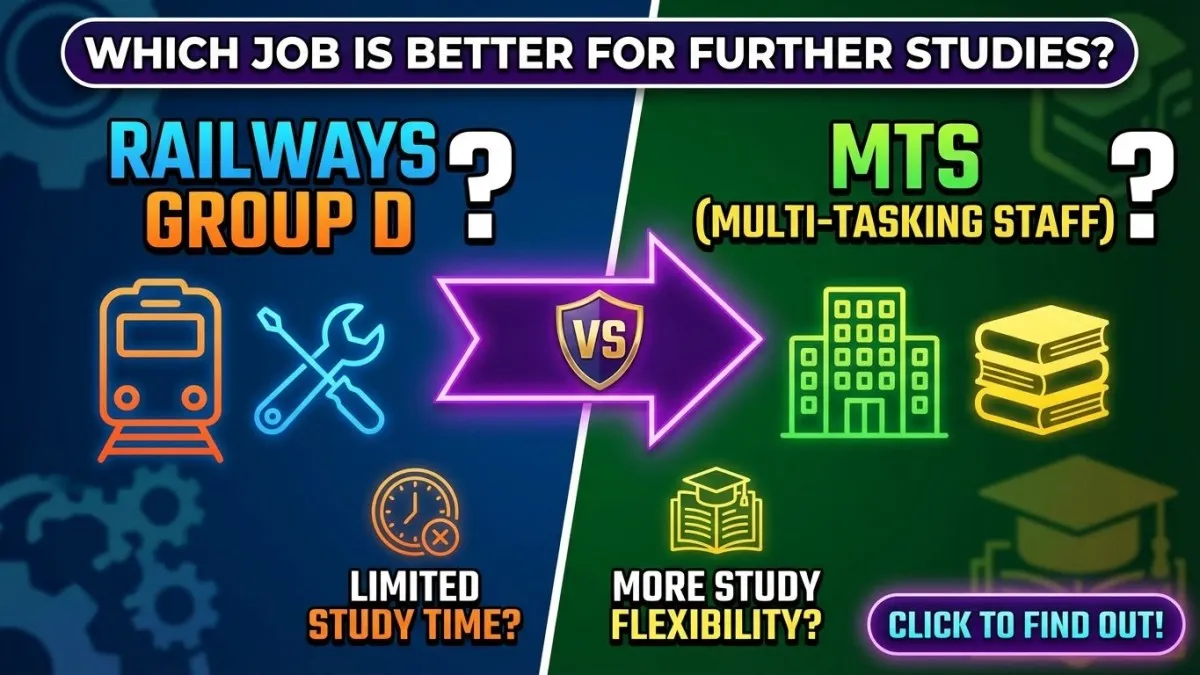
Railways Group D vs. MTS Your Confusion is Real (And I Understand It)
You are standing at a crossroads right now.
You have two job offers in your hand – Railways Group D and MTS (Multi-Tasking Staff).
Both are government jobs. Both give you security. Both pay decent money.
But here’s the question that’s eating you up inside:
“Which job will let me study further and prepare for bigger exams like SSC CGL or UPSC?”
Your father says take Railways because “beta, railway mein pension achhi hai.”
Your friend says MTS is better because “kam kaam hai, zyada time milega.”
And you? You’re confused. You’re scrolling through forums at 2 AM looking for answers.
I get it. Because I’ve guided 1000+ students facing this exact problem.
Today, I’m going to break down everything for you like a big brother. No sugar-coating. Pure reality.
Let’s go.
The Reality Check: Why Most People Choose Wrong (And Regret Later)
Here’s what happens to 70% of students who take these jobs:
First 6 months: You’re excited. You join the job. You tell yourself “I’ll study 4 hours daily after office.”
After 1 year: You’re tired. The job drains you. You study maybe 1 hour. Or not at all.
After 2 years: You look at your friends who kept preparing. Some cleared SSC CGL. Some are preparing for UPSC. And you? You’re stuck.
Why does this happen?
Because you chose the job based on salary or what others said.
You didn’t think about:
- Your actual work hours
- Mental and physical exhaustion
- Study leave policies
- Transfer issues
- Your long-term exam goals
Today, we fix this mistake BEFORE you make it.
Understanding the Jobs First: Railways Group D vs. MTS
Let me break down what these jobs really look like:
Railways Group D: The Ground Reality
What you’ll do:
- Track maintenance work
- Helper duties in stations
- Physical labor work
- Assisting technicians
Work hours: 8-10 hours (sometimes more during emergencies)
Salary: ₹18,000 – ₹22,000 per month (after 7th Pay Commission)
The Truth Nobody Tells You:
- Work is physically demanding
- Shift duties (day/night rotations)
- You’ll be exhausted after work
- Transfers happen frequently
MTS (Multi-Tasking Staff): The Ground Reality
What you’ll do:
- Office cleaning and maintenance
- Photocopying and file carrying
- Tea/coffee arrangements (yes, really)
- Basic office support work
Work hours: 9 AM – 5:30 PM (fixed, mostly)
Salary: ₹18,000 – ₹25,000 per month (varies by department)
The Truth Nobody Tells You:
- Work is less physically demanding
- Fixed office hours (usually)
- You’ll have mental energy left
- Less transfer issues in most departments
The Big Comparison Table: Side by Side Reality
| Factor | Railways Group D | MTS | Winner for Studies |
|---|---|---|---|
| Physical Work | Heavy (track work, lifting) | Light (office support) | ✅ MTS |
| Mental Energy Left | Low (you’ll be tired) | Moderate to High | ✅ MTS |
| Study Time | 1-2 hours max | 3-4 hours possible | ✅ MTS |
| Fixed Timings | No (shift duty) | Yes (9-5 usually) | ✅ MTS |
| Study Leave | Difficult to get | Easier (depends on dept) | ✅ MTS |
| Transfers | Frequent | Less frequent | ✅ MTS |
| Job Respect | Good | Considered “lower” | ⚠️ Railways |
| Coaching Access | Hard (shift timings) | Easier (fixed hours) | ✅ MTS |
| Weekend Study | Often working weekends | Weekends mostly off | ✅ MTS |
| For UPSC Prep | Very difficult | Possible | ✅ MTS |
| For SSC CGL Prep | Difficult but doable | Good option | ✅ MTS |
Clear Winner for Further Studies: MTS (Multi-Tasking Staff)
The Solution: 4-Step Decision Framework
Step 1: Know Your Exam Goal (Be Honest)
Ask yourself right now:
“What exam do I really want to clear in next 2-3 years?”
- If SSC CGL or CHSL: MTS is better. You need consistent study time.
- If Railway RPF or higher Railway exams: Railways Group D gives you internal knowledge advantage.
- If UPSC: MTS is MUCH better. UPSC needs 6-8 hours daily study.
- If you just want a stable job and no further studies: Choose based on work preference.
Write down your goal. Right now. On paper.
Step 2: Check Your Physical Capacity
Be brutally honest:
- Can you do physical labor 8 hours and then study?
- Do you have any health issues?
- Are you okay with night shifts?
If you answered NO to any question above → Choose MTS.
Step 3: Check Your Family Situation
This is important:
- Will your family support you if you study after work?
- Can you afford coaching fees from your salary?
- Will frequent transfers (Railways) disturb your preparation?
If transfers are a problem → Choose MTS in a central department.
Step 4: Check Your Study Consistency History
Look at your past:
- Did you study consistently during graduation?
- Or did you study in last-minute bursts?
If you’re NOT a consistent student → Railways will kill your dreams. Choose MTS.
Because MTS gives you second chances. Railways will drain you.https://www.oliveboard.in/blog/rrb-group-d-vs-ssc-mts/https://www.oliveboard.in/blog/rrb-group-d-vs-ssc-mts/
The “Secret Sauce”: The 3-Year Strategy Nobody Talks About
Here’s what toppers who joined MTS and cleared bigger exams did:
Year 1: Settle + Build Foundation
- First 3 months: Just adjust to the job
- Next 9 months: Study 2 hours daily (basics only)
- Don’t attempt any big exam yet
- Focus: Get comfortable with your routine
Year 2: Serious Preparation Begins
- Study 3-4 hours daily (morning + evening)
- Join online coaching (affordable + flexible timing)
- Attempt mock tests every Sunday
- Focus: Cover full syllabus of your target exam
Year 3: Final Push
- Study 4-5 hours daily
- Take study leave for 1-2 months before exam
- Join test series programs
- Focus: Revision + test practice
The Game-Changer Resource:
Here’s where 90% of students fail: They don’t have a proper study plan.
They waste time figuring out “what to study today.”
You need a ready-made study roadmap that tells you:
- Exactly what to study each day
- How to manage job + studies
- Which books to use
- Time-table strategies
[This is where I recommend using a structured preparation guide specifically designed for working government employees who want to prepare for higher exams. A good guide can save you 6 months of confusion and trial-and-error.]
Real Success Stories (To Motivate You)
Rajesh from Bihar:
- Joined MTS in 2020
- Studied 3 hours daily after office
- Cleared SSC CGL in 2023
- Now works as Tax Assistant (salary ₹45,000+)
Priya from Uttar Pradesh:
- Joined Railways Group D in 2019
- Struggled to study due to shift work
- Left after 2 years (lost time)
- She says: “If I could go back, I’d choose MTS”
Vikram from Madhya Pradesh:
- Joined MTS in 2021
- Prepared for UPSC alongside
- Cleared UPSC Prelims in 2024
- Still preparing for Mains (on study leave)
The pattern is clear: MTS gives you breathing space. Railways doesn’t.
My Personal Advice: What I’d Do If I Were You
If you asked me: “Bhaiya, what should I choose?”
Here’s what I’d say:
Choose MTS if:
✅ You’re serious about SSC CGL, CHSL, or UPSC
✅ You need fixed work hours
✅ You value study time over job prestige
✅ You’re okay with basic office work
✅ You want to join coaching classes
Choose Railways Group D if:
✅ You want better job respect in society
✅ Physical work doesn’t bother you
✅ You’re targeting internal Railway promotions
✅ You’re NOT planning bigger exam preparation
✅ You want to settle in life (job-wise)
Bottom line: If studies are your priority, MTS wins. No debate.
Common Mistakes to Avoid (Learn from Others’ Pain)
Mistake #1: Choosing Based on Salary Alone
Both jobs have similar salary. Don’t fall for ₹1000-2000 difference.
Mistake #2: Listening to Everyone
Your uncle, your friend, random people on forums – everyone will give advice.
Listen to people who actually prepared for Govt Exam Preparation 2025 while working.
Mistake #3: Thinking “I’ll Manage Both”
No, you won’t. Not without a proper Exam Strategy.
Railway Group D + UPSC = 99% failure rate
MTS + SSC CGL = Much better success rate
Mistake #4: Not Planning for Study Leave
Check study leave rules BEFORE joining. Some departments give 2 years study leave. Some give zero.
Ask HR during joining about study leave policy.
The Exam Strategy Comparison Table
Here’s how your preparation difficulty changes with each job:
| Target Exam | With Railways Group D | With MTS |
|---|---|---|
| SSC CGL | Very Hard ⭐⭐⭐⭐⭐ | Moderate ⭐⭐⭐ |
| SSC CHSL | Hard ⭐⭐⭐⭐ | Easy ⭐⭐ |
| Railway RPF | Easy ⭐⭐ | Moderate ⭐⭐⭐ |
| UPSC (IAS) | Nearly Impossible ⭐⭐⭐⭐⭐ | Hard but Possible ⭐⭐⭐⭐ |
| Banking PO | Hard ⭐⭐⭐⭐ | Moderate ⭐⭐⭐ |
| State PCS | Very Hard ⭐⭐⭐⭐⭐ | Hard ⭐⭐⭐⭐ |
(More stars = more difficult)
See the pattern? MTS consistently makes preparation easier.
Sarkari Naukri Tips: The Practical Stuff
Before You Join (Either Job):
Tip #1: Research Your Posting Location
- Is there a good library nearby?
- Are coaching centers accessible?
- Can you afford rent + coaching from salary?
Tip #2: Talk to Current Employees
- Message people on LinkedIn who work in that role
- Ask them: “How much time do you get to study?”
- Real experiences > recruitment advertisements
Tip #3: Negotiate Your Posting (If Possible)
- Some departments allow posting preference
- Choose posting near your home or near coaching hubs (Delhi, Patna, Jaipur)
Tip #4: Join Online Communities
- Join Telegram groups of your department
- Learn from seniors’ experiences
- Get study leave information
Your 30-Day Action Plan After Joining
Week 1-2: Observation Mode
- Understand your work completely
- Don’t stress about studies yet
- Learn office culture
- Make good relations with seniors
Week 3-4: Light Preparation
- Start reading newspapers (15 minutes daily)
- Revise basic GK (30 minutes daily)
- Don’t burn out
Month 2 Onwards: Serious Mode
- Create fixed study schedule
- Study 2 hours daily minimum
- Join online test series
- Track your progress weekly
Remember: Slow and steady wins. Don’t try to study 8 hours from day 1.
read more:Marriage Certificate Registration 2025: Complete Guide for Newlyweds (Important for Government Jobs)
Conclusion: Your Decision, Your Future
Let me tell you something important:
Both Railways Group D and MTS are good jobs.
Both give you:
- Job security
- Decent salary
- Government benefits
- Respect in society
But here’s the reality:
If you want to study further and clear bigger exams, MTS is the smarter choice.
It’s not about which job is “better.”
It’s about which job gives you time, energy, and mental space to chase your dreams.
Don’t choose based on what your parents say.
Don’t choose based on social pressure.
Choose based on YOUR exam goals.
Because 3 years from now, when your MTS colleague clears SSC CGL and gets promoted to Income Tax Inspector…
You don’t want to be the Railway Group D employee thinking: “I wish I had chosen differently.”
The choice is yours. But now you have the full picture.
Make a decision today. Write it down. Commit to it.
And then work your ass off.
Success doesn’t care which job you’re doing. Success cares about how badly you want it.
All the best, my friend.
You’ve got this. 💪
(Now stop reading and start planning. Your dream job is waiting for you.)
Q1: Can I switch from Railways Group D to MTS later?
Answer:
Technically yes, but it’s very difficult and time-consuming.
You need to:
Resign from Railways (lose all benefits)
Apply fresh for MTS
Start from zero again
Better approach: Choose correctly the first time.
If you’re confused, go for MTS. Because MTS → Railways promotion is easier than the reverse.
Q2: Which job has better promotion opportunities without exams?
Answer:
Railways Group D has better internal promotions.
You can get promoted to:
Level 2 positions after 3 years
Technician roles after 8-10 years
But here’s the catch: These promotions take TIME and you’ll still be doing physical work.
MTS promotions are slower but your work remains easier.
My advice: If you’re serious about SSC CGL or UPSC, promotions don’t matter. You’ll leave this job anyway in 2-3 years.
If you’re NOT serious about further studies, Railways gives better long-term career within the same department.
Q3: I’m planning for UPSC. Should I even take any of these jobs or just prepare full-time?
Answer:
This is the MILLION DOLLAR QUESTION.
Here’s my honest answer:
Take MTS if:
You need financial stability (family pressure, loans, expenses)
You’ve already failed UPSC once or twice
You need backup security while preparing
Your family can’t support you for 2-3 years
Prepare full-time if:
Your family can support you financially
You’re under 24 years old (time is on your side)
You have strong basics already
You can handle pressure and uncertainty
The harsh truth: Very few people clear UPSC while working full-time.
But MTS + UPSC is still MUCH better than Railways Group D + UPSC.
If you take MTS, plan to take study leave for at least 1 year when you’re serious about UPSC.
Bottom line for Govt Exam Preparation 2025: Having a government job as backup reduces pressure. But only if that job gives you time to prepare. That job is MTS, not Railways Group D.